
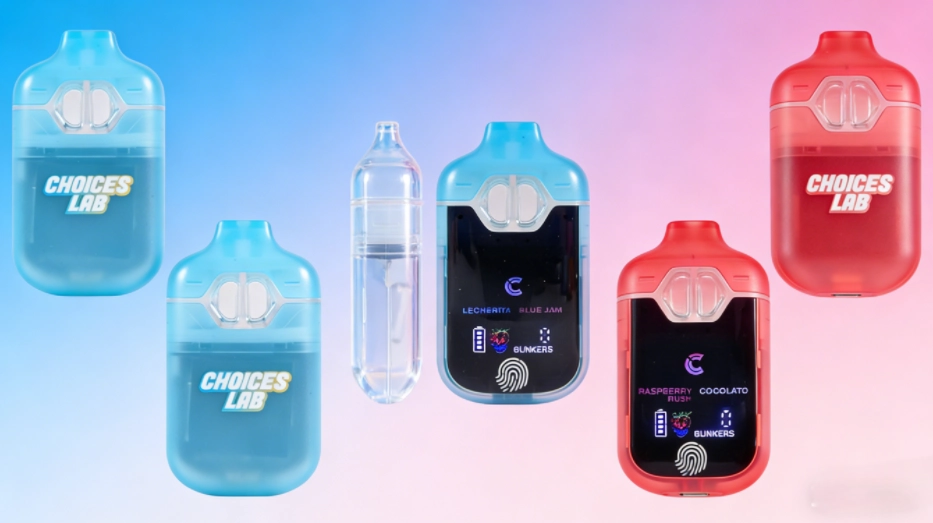
Exploring the Benefits of Using choicelab vape for Vaping
Keyword: choicelab disposable
Modern disposable vape hardware wins because it delivers repeatable flavor, a low learning curve, and stable performance from the first puff to the last. If you’re evaluating a choicelab vape (hardware-only) or planning a private-label run that mirrors its design, this engineering-first brief explains why this format works—and how to spec and QC it with defensible methods.
1) Market momentum
Disposables are scaling fast. Industry tracking shows disposables grew their share of vape sales strongly from 2022–2024 and now account for roughly a quarter of category dollars across tracked legal markets—driven by convenience and ease of use (BDSA category insights).
Younger adults over-index on pens. Combined Gen Z + Millennials represent the majority of U.S. cannabis spend and an even higher share of vapor-pen purchases, pointing to sustained demand for simple, consistent devices (Flowhub, citing Headset).
2) Ceramic atomizers & consistency
Most current-gen disposables pair a micro-porous ceramic core with precisely sized inlet ports. Versus legacy cotton, ceramics distribute heat more evenly and stabilize wicking—fewer dry hits, less flavor drift.
- Vendor data on next-gen ceramics (use as hypotheses to validate on your own liquid/draw): CCELL EVO technical review, FEELM platform overview.
- Spec starting points for a choicelab disposable: coil resistance ~1.2–1.6 Ω; inlets 4–6× at ~1.5–1.6 mm each to handle thicker blends without flooding; short, gentle ramp to optimize the first puff.
Note: Outcomes depend on formulation viscosity and device geometry—run side-by-side trials.
3) Power delivery, battery, runtime
Capacity (mAh) is only part of the story. Devices win when they manage power curves to keep flavor stable near end-of-charge, avoid hot spots, and expose clear state-of-charge signals (LED/screen). Medium power usually balances taste/runtime best; high power is great for short, dense pulls if wicking keeps up. Board-level protections (over-current, over/under-voltage, thermal) and USB-C charging improve field reliability.
4) Airflow, draw & lab methods
Anchor cross-SKU comparisons to recognized lab regimes so results are comparable:
- ISO 20768 baseline: 55 mL puff volume, 3 s duration, 30 s puff period—useful for incoming QA and vendor discussions (ISO 20768:2018 overview).
- CORESTA (2024) notes that high-airflow devices can overheat under the ISO low-flow regime and points to a differentiated approach (EN 17957) for those products (CORESTA Guide No. 25, July 2024).
For a choicelab vape tuned to an MTL-leaning draw, the ISO regime works well as a common test language; adapt if you intentionally design for higher airflow.
5) Windows, shells & stress cracking
Oil windows and shells see chemicals, heat, grip pressure, and pocket stress. PCTG/Eastman Tritan™ is widely used for its clarity and resistance to environmental stress cracking (ESC), making it a solid choice for level-check windows and touch surfaces.
- Material reference: Eastman Tritan™ overview, PC material properties (UL Prospector).
- Build checklist: window in ESC-resistant grade; shell in PC or alloy with abrasion/sweat testing; silicone seals with appropriate Shore hardness; confirm compression set after 72-hour soak; verify clarity after thermal cycling.
6) Cold starts, altitude & real-world stability
Most “felt harsh / flooded” tickets come from cold stock or post-flight pressure changes. A robust choicelab disposable mitigates both by:
- Supporting a brief higher output on the first 2–3 puffs of a cold device, then settling at medium.
- Using capillary-friendly inlets and reliable seals so pressure swings don’t push oil into the chimney.
- Logging first-puff smoothness, flavor drift over 10 puffs, aerosol noise, and end-of-charge behavior in QA runs (see ISO/CORESTA above).
7) 15-minute QA you can run today
- Condition samples 24 h @ 20–22 °C → 30 min room-temp rest.
- ISO-style test: 10 puffs per power step (low/med/high): record first-puff smoothness, flavor stability, sputter/noise.
- Cold check: 2 h @ 0–5 °C → 5 puffs on medium → confirm smoothness returns.
- Stand 10 min → inspect mouthpiece/body for seep/condensate.
- Log puff count per step and state-of-charge decline; reject outliers.
8) Operations & sustainability note
Disposables combine electronics and lithium cells. For store programs and returns, U.S. guidance advises not to place e-cigs in household trash or curbside recycling; route them to appropriate household hazardous-waste collection where available (U.S. EPA: Disposal guidance).
Bottom line
A well-specified choicelab vape succeeds because it makes performance predictable: ceramic cores for smoother starts, tuned airflow for familiar draw, smart power for flavor to the last puff, and materials that stand up to real-life handling. Anchor vendor talks and QA to ISO/CORESTA methods, validate claims on your own liquids, and you’ll ship a choicelab disposable that feels the same on day one—and day 100—of your program.
::contentReference[oaicite:0]{index=0}
People can find thc vape in following pages: dual chamber vape pen | custom choice lab vape | disposable vape cheap
0 Comments