
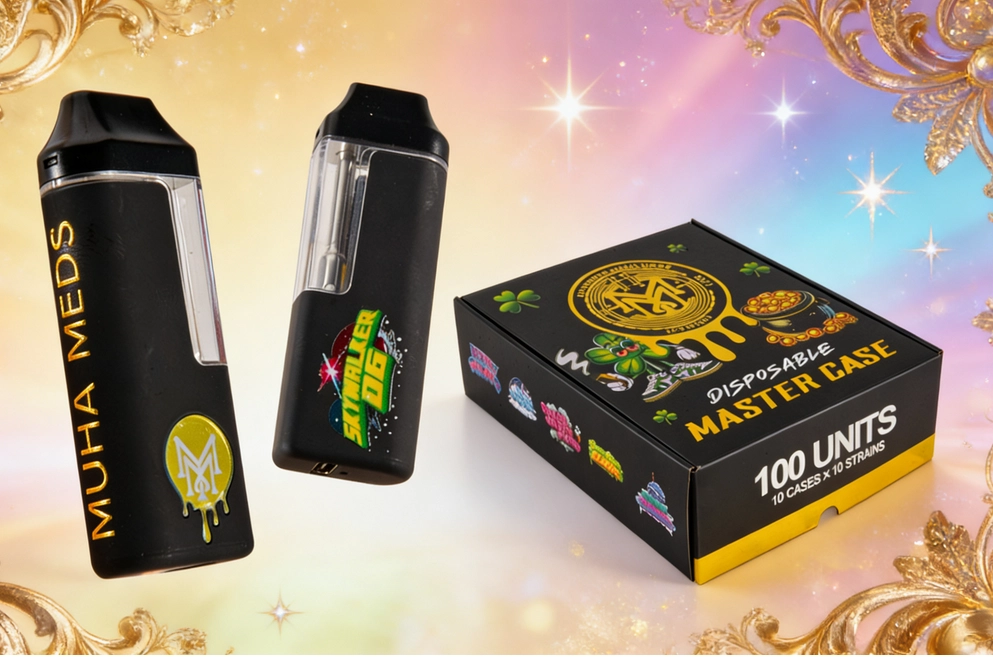
Exploring the Benefits of Variable Voltage muha meds disposable for an Enhanced Vaping Experience (MoFu)
Summary: Variable voltage (VV) lets buyers tune a disposable’s heat profile to the liquid and coil. Within the coil’s safe power window, stepping voltage upward generally increases aerosol output and shifts particle-size distributions—perceived as fuller flavor and denser “body.” Using standardized puffing (≈55 mL, 3 s, one puff/30 s) makes those gains repeatable across panels and climates. :contentReference[oaicite:0]{index=0}
What VV actually changes (the short science)
Coil power follows W = V² / R. For a typical disposable-class coil (~1.4 Ω), stepping the dial from 3.2→3.8→4.2 V raises power from ~7.3→~10.3→~12.6 W—clearly warmer and denser if wicking keeps up. In controlled studies, higher power increases aerosol yield and alters count/mass distributions (what users perceive as “richer” vapor). :contentReference[oaicite:1]{index=1}
| Voltage | Power @ 1.4 Ω | Typical perception |
|---|---|---|
| 3.2 V | ~7.31 W | Cooler, lighter, smoother |
| 3.8 V | ~10.31 W | Balanced warmth & flavor “pop” |
| 4.2 V | ~12.60 W | Warm/dense—watch for over-drive signs |
For apples-to-apples comparisons, benchmark under a standard puffing regime (≈55 mL, 3 s, every 30 s) used by CORESTA/ISO so panel notes and gravimetric results are comparable across batches. :contentReference[oaicite:2]{index=2}
Matching VV to liquid viscosity (why winter vs. summer feels different)
Carrier viscosity sets how fast the wick replenishes. At ~20 °C, propylene glycol (PG) sits on the order of tens of mPa·s, while glycerol (VG) is ~103 mPa·s—orders of magnitude thicker. As temperature rises, both thin markedly. Practically, colder/thicker liquids may need a slight voltage bump (within spec) to keep puffs from feeling “starved”; in warm rooms, backing off reduces “over-rich” or spitty pulls. :contentReference[oaicite:3]{index=3}
Bench playbook: dialing in a VV muha meds disposable
- Fix the regimen. Test with ~55 mL, 3 s puffs at 30 s intervals (same liquid batch, same room temp). Log flavor intensity, warmth, smoothness, aftertaste. :contentReference[oaicite:4]{index=4}
- Step in small increments. Start ~3.2–3.6 V and move in 0.2 V steps until taste cleans up and density plateaus (often ~7–13 W with 1.2–1.6 Ω coils). Evidence shows aerosol output rises with power—up to the point wicking or thermal limits push back. :contentReference[oaicite:5]{index=5}
- Confirm with gravimetrics. Weigh device before/after 10 standardized puffs. Stable, higher consumption with clean taste indicates a productive setting. (This aligns with lab findings relating power to aerosol yield.) :contentReference[oaicite:6]{index=6}
- Avoid over-drive. If panel detects harshness/dryness, step down. Carbonyls climb at excessive power and especially under “dry-puff” conditions—something users naturally avoid because it tastes bad. :contentReference[oaicite:7]{index=7}
What buyers (and their customers) feel when VV is tuned right
- Fuller flavor & body: increased particle count/mass at higher—but appropriate—power translates to denser, more satisfying puffs. :contentReference[oaicite:8]{index=8}
- Consistency across climates: adjust voltage slightly to compensate for ambient temperature/viscosity shifts and keep the hand-feel steady store-to-store. :contentReference[oaicite:9]{index=9}
- Personalized “throat hit”: power and puff duration jointly shape intensity; using a standardized 3 s baseline makes it easy to reproduce a target feel. :contentReference[oaicite:10]{index=10}
MoFu spec checklist for a VV-capable muha meds disposable
- Voltage window & step size: e.g., 3.2–4.2 V with 0.1–0.2 V steps so a 1.2–1.6 Ω coil lands ~7–13 W.
- Coil & wicking match: inlet count/diameter + ceramic micro-porosity sized for your target viscosity band; validate with equal-puff weight-loss tests. :contentReference[oaicite:11]{index=11}
- Puff detection & airflow: a pressure/air-switch that triggers reliably across typical flow rates used in the 55/3/30 regimen. :contentReference[oaicite:12]{index=12}
- Thermal behavior: smooth ramp with no overshoot at the top of the range; avoid signatures linked to dry-puff/over-heating in bench work. :contentReference[oaicite:13]{index=13}
- Simple UI: LED/screen cues for low-voltage and time-out so users can self-tune without guesswork.
FAQ
Does higher voltage always mean “better”?
No. Up to a point, more power raises aerosol output and warmth; beyond the coil/liquid window, taste degrades (“dry/harsh”). Your “best” setting maximizes density while keeping flavor clean under a standard puff profile. :contentReference[oaicite:14]{index=14}
Will users really notice VV?
Yes—especially across climates and with different liquid viscosities. VV lets staff quickly recover consistency on cold days (slight bump) or tame overly hot/“spitty” behavior in warm stores (slight drop). :contentReference[oaicite:15]{index=15}
What’s a practical starting wattage?
For MTL-leaning disposables around ~1.4 Ω, start near 3.2–3.6 V (≈7–9 W) and step in 0.2 V increments, evaluating taste and smoothness under 55/3/30 conditions. :contentReference[oaicite:16]{index=16}
References you can cite in sales decks
- Power ↔ aerosol yield/particle size: Floyd et al., PLoS ONE 2018; Gillman et al., Toxicology in Vitro 2016; recent aerosol work on power & distributions. :contentReference[oaicite:17]{index=17}
- Standardized puffing for comparability: CORESTA CRM 81 and ISO 20768 define ~55 mL, 3 s puffs, one/30 s for lab benchmarking. :contentReference[oaicite:18]{index=18}
- Viscosity gap & temperature effects: PG in the tens of mPa·s near 20–25 °C; glycerol ~103 mPa·s with strong temp dependence (Sigma/industry TDS; glycerine property compendium). :contentReference[oaicite:19]{index=19}
- Avoiding harsh “dry-puff” conditions: carbonyls climb at excessive power/over-heat; realistic-use testing is key. :contentReference[oaicite:20]{index=20}
::contentReference[oaicite:22]{index=22}
People can find wholesale vape shop in following pages: 2g disposable vape | wholesale muha meds 2g | muha meds master case bulk
0 Comments