
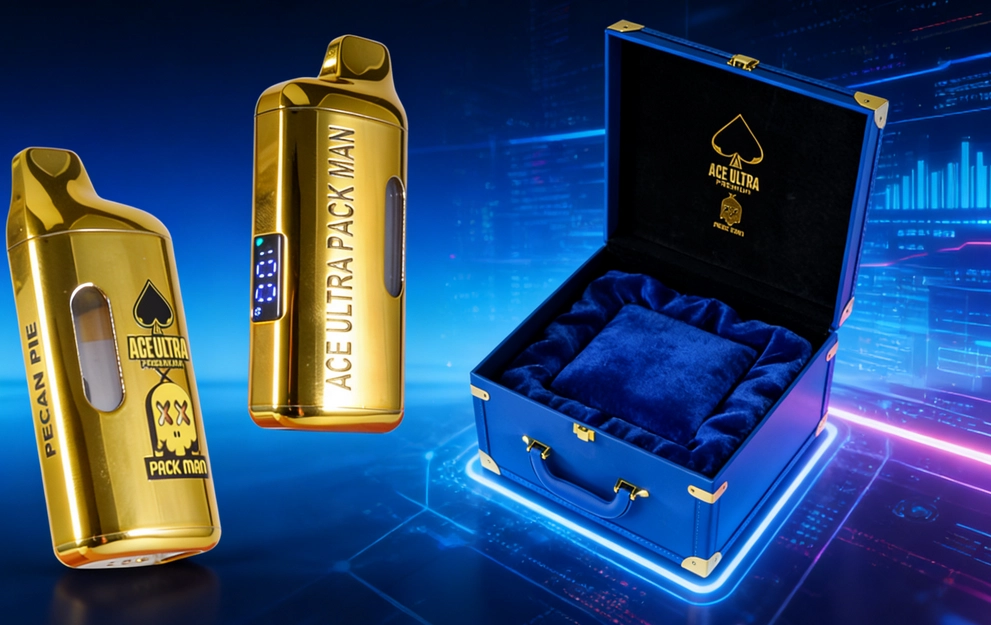
ACE Packman V2 (Empty Device) — A Technical Buyer’s Guide for B2B Programs
Keyword focus: ace packman v2. This article covers atomization physics, airflow & draw feel, leak-control stack, battery/USB-C behavior, materials, and a lab-ready QC matrix. No legal/regulatory topics.
1) What “V2” Should Mean in Practice
In B2B terms, a V2 refresh should deliver measurably better consistency under realistic use—higher reproducibility of aerosol output (TPM), tighter draw-force windows, stronger leak resistance after temperature cycling, and a cleaner user-perceived “first-puff to last-puff” curve. The quickest way to prove it is by running standardized puffing regimes and environmental tests, then publishing the deltas versus your previous batch. ISO 20768 defines a baseline 55 mL / 3 s / 30 s regime for lab comparability, while CORESTA highlights that many modern high-airflow devices require a different regime to avoid coil overheating artifacts during testing. :contentReference[oaicite:0]{index=0}
2) Vapor Performance & Test Regimes (ISO vs. High-Airflow)
To characterize ace packman v2 objectively, collect TPM (mg/puff) and temperature traces under two regimes: (A) ISO 20768 standard (55 mL puff volume, 3 s duration, 30 s interval), and (B) a high-airflow regime per CORESTA guidance to prevent artificial “dry-puff”-like overheating when flow demand exceeds 55 mL. The rationale: CORESTA reports that applying 55 mL to high-airflow designs can overheat the heater, skewing chemistry and sensory readouts. :contentReference[oaicite:1]{index=1}
Supplemental reading shows how puff topography (volume, duration, inter-puff interval) shifts heater temperature and efficiency—useful when tuning power curves and wicking. :contentReference[oaicite:2]{index=2}
3) Airflow, Draw Force & Sensor Response
Draw feel is a function of internal flow path, leak paths, and the pressure differential that triggers the air-switch. Record pressure-drop and sensor-trigger latency during the first 5 puffs to capture wick saturation dynamics. Use the ISO 20768 setup for baseline comparability and the CORESTA high-airflow regime for products marketed as “airy” or “open draw.” :contentReference[oaicite:3]{index=3}
- Targets (typical MTL-leaning draw): trigger at low, stable pressure differential; no flutter; latency <150 ms once wick is primed.
- Data to log: pressure vs. time, heater PWM/NTC readings, and “early-puff” temperature spikes (if any).
4) Leak-Control Stack & Environmental Robustness
The fastest real-world kill-tests for leak control combine static rest, negative-pressure exposure, and temperature cycling. An established lab method is to run change-of-temperature tests (e.g., −20 °C ↔ +60 °C cycles) to stress seals, interfaces, and air entrapment, then do mass-loss checks and visual inspections. IEC 60068-2-14 is the canonical reference for change-of-temperature testing and is frequently paired with vibration/drop sequences in broader reliability plans. :contentReference[oaicite:4]{index=4}
5) Battery Runtime, Cold-Weather Behavior & USB-C Durability
Most runtime complaints in cold markets trace back to temperature-dependent Li-ion behavior (higher internal resistance, reduced available capacity). When benchmarking ace packman v2, capture runtime at 0–5 °C vs. 23 °C to model “usable puffs” under local conditions; contemporary studies show strong temperature and regimen dependencies. :contentReference[oaicite:5]{index=5}
For charging hardware, specify and test USB-C connectors for mechanical endurance. The USB Type-C spec sets a minimum durability rating of 10,000 insertion/extraction cycles; many lab and vendor notes reiterate this threshold. Design the PCB and shell to protect the receptacle from shear during angled pulls. :contentReference[oaicite:6]{index=6}
6) Materials: PCTG Windows, PC/Metal Shells
PCTG is a common choice for oil windows and clear housings due to impact resistance and transparency; it’s widely cited as BPA-free and used across drinkware and small appliances, with industry notes explicitly listing e-cigarette parts among typical applications. For outer shells, PC provides rigidity while aluminum/steel frames add thermal mass and tactile quality—balance grip coatings against scratch and sweat resistance in field tests. :contentReference[oaicite:7]{index=7}
7) Inbound QC: A Practical 10-Point SOP
- Puffing Baseline — ISO 20768 regime: TPM across first 50 puffs; temperature probe on chimney. :contentReference[oaicite:8]{index=8}
- High-Airflow Check — Repeat on CORESTA high-airflow regime for “airy” units; confirm no overheating artifacts. :contentReference[oaicite:9]{index=9}
- Draw-Force Window — Pressure-drop & trigger-latency maps (n≥5 per lot). :contentReference[oaicite:10]{index=10}
- First-to-Last Puff Curve — Heater control (PWM/NTC), “no harsh spike” criterion; cross-read with topography literature. :contentReference[oaicite:11]{index=11}
- Leak-Control — −20↔+60 °C cycles; weigh-back and optical inspection. :contentReference[oaicite:12]{index=12}
- Cold-Runtime — Runtime at 0–5 °C vs. 23 °C; log voltage sag and cut-off behavior. :contentReference[oaicite:13]{index=13}
- USB-C Endurance — Bench to 10k mating cycles with post-test contact-resistance check. :contentReference[oaicite:14]{index=14}
- Connector Shear Test — Off-axis pull on cable at 1–3 N; inspect solder joints and shell supports. :contentReference[oaicite:15]{index=15}
- Materials Spot-Check — Verify PCTG windows (transmittance/impact notes) on incoming lots. :contentReference[oaicite:16]{index=16}
- Sensory Panel — 10–20 puffs per unit across multiple units; record descriptors and variance; link back to TPM curves. :contentReference[oaicite:17]{index=17}
8) Spec Targets & Lab Matrix for ace packman v2
Use the table below as a starting point for engineering discussions and supplier scorecards. Values represent target ranges commonly used for empty, rechargeable disposables—adjust for your market and oil characteristics.
| Subsystem | Target / Method | How to Verify (Key References) |
|---|---|---|
| Atomizer & Wicking | Ceramic heater; effective resistance ~1.2–1.6 Ω; stable capillary feed for mid-viscosity oils | TPM & temp profiles under ISO 20768; confirm no overheating under high-airflow regime per CORESTA. :contentReference[oaicite:18]{index=18} |
| Draw Feel | Consistent trigger; no flutter; tight pressure-drop window matched to MTL-leaning profile | Pressure vs. time + trigger latency under standardized puffing. :contentReference[oaicite:19]{index=19} |
| Leak Control | Zero visible leak after −20↔+60 °C cycles (≥5 cycles), followed by 24 h rest | Change-of-temperature test (IEC 60068-2-14) + weigh-back. :contentReference[oaicite:20]{index=20} |
| Runtime & Cold Behavior | Minimal perceived drop at 0–5 °C vs. room temperature; no premature low-voltage cut-off | Cold-room runtime runs; analyze temperature-dependent Li-ion behavior. :contentReference[oaicite:21]{index=21} |
| USB-C Port | ≥10,000 insertion cycles; stable contact resistance; robust shell anchoring | USB-IF Type-C spec durability; add off-axis pull test. :contentReference[oaicite:22]{index=22} |
| Oil Window | PCTG with high clarity and impact resistance | Supplier datasheets listing e-cig applications & properties. :contentReference[oaicite:23]{index=23} |
9) Short FAQ for B2B Teams
Q1. Why do lab results sometimes disagree with store feedback?
A. If you only test on 55/3/30, high-airflow designs may overheat on the rig and look worse than they actually are. Add a high-airflow regime per CORESTA to align lab data with real inhalation behavior. :contentReference[oaicite:24]{index=24}
Q2. What single upgrade most improves perceived quality for ace packman v2?
A. Tightening heater control on the first 3–5 puffs (wick-wetting phase) and stabilizing draw-trigger latency usually produces the biggest, most visible lift in panel scores. See topography-driven studies for the mechanism. :contentReference[oaicite:25]{index=25}
Q3. What should we publish to win over retail partners?
A. Two overlays: (1) ISO vs. high-airflow TPM curves; (2) leak-free rate after temp cycles. Add a USB-C 10k-cycle certificate snapshot and a PCTG material call-out. :contentReference[oaicite:26]{index=26}
::contentReference[oaicite:27]{index=27}
People can find vape bulk in following pages: ace packman wholesale | wholesale ace packman disposable | custom 2ml thc vape
0 Comments